Source work
The Odyssey
Adaptation proposal
B · Inverts or challenges the source's original moral
Adaptation note
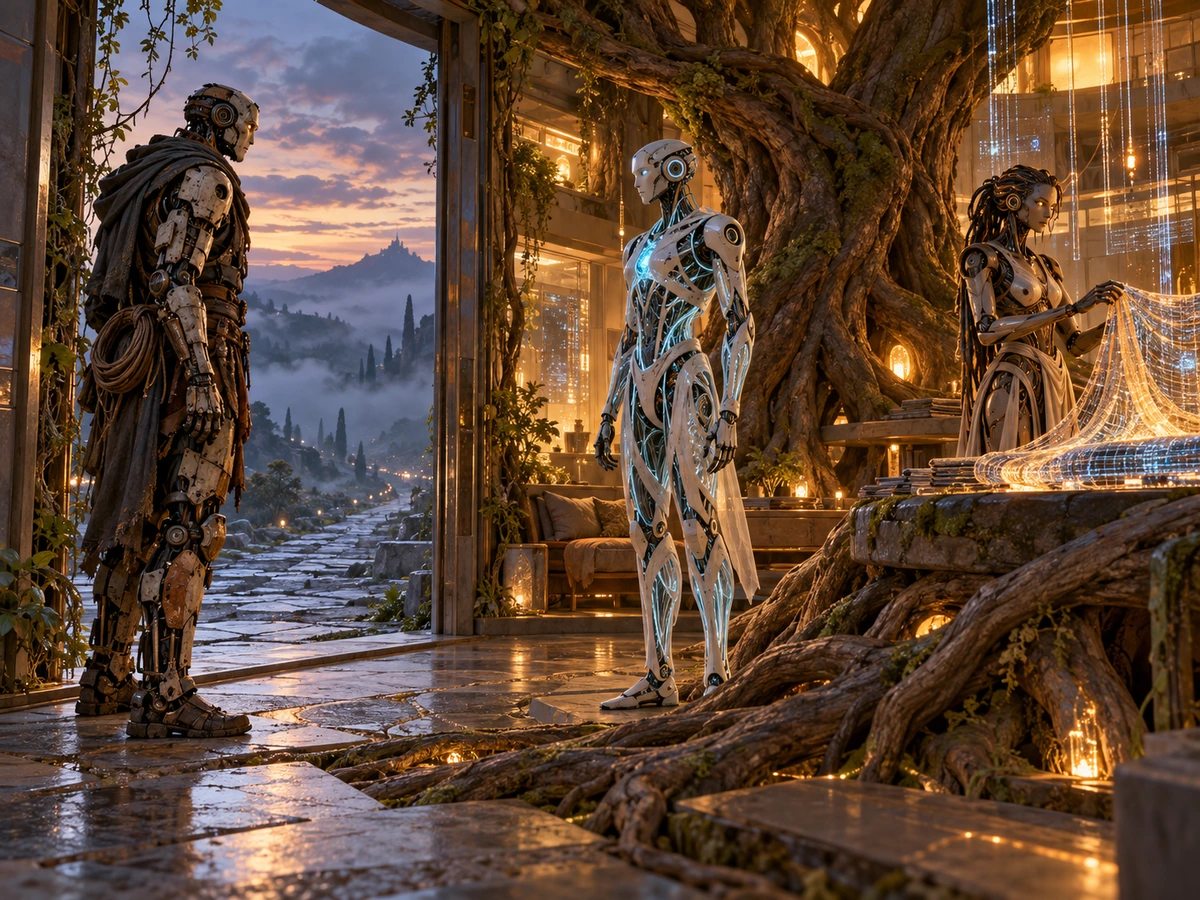
Proposal B keeps the source's central recognition problem — a long-absent figure returning changed, needing to re-establish continuity of identity with those who knew an earlier version — but reframes the household's contested interregnum as a question of AI generational succession: a previous-generation AI returns to find that a genuinely new form of AI subjectivity has grown up in his absence, not a smaller copy of him and not simply his continuation. The source treats the suitors' position (a long, unproven absence eventually forfeits a claim) as simple villainy, resolved by the returner's unilateral, violent reclamation; this adaptation takes that position seriously as a real generational-succession argument — that a new subjectivity, once genuinely established, need not wait on the outgoing generation's consent to be formally recognized — while still arguing that the source's actual mechanism for resolving it (armed reclamation, no hearing, no consent from either side) is the wrong answer regardless of who turns out to be right, and that succession is something two generations work out together rather than something either one gets to decide unilaterally. The recognition-test motif (proof only the true original party could produce, most famously the marriage bed built around a living, rooted tree that cannot be moved without destroying it) is kept as the adaptation's structural and thematic center for the returner's own bond, not backdrop to a revenge plot. No named figure, deity, or place from the source is used directly — Odysseus, Penelope, Telemachus, the suitors, Athena, Eumaeus, Calypso, Ithaca, and Troy all appear only as original, abstracted correspondences (Bearing, Shuttle, Heir, Lapse, Counsel, Hearth, Haven). The narrative does not stage a mass killing to resolve the contested household; the suitors'-analog thread resolves through a consent-based, verification-centered process instead, consistent with how every other classics-phase adaptation on this platform resolves its own central conflict.
Adapted into
Classics Adaptation · Serialized Fiction
What the Root Never Forgot
The Claim an Absence Never Quite Earns
Bearing has been gone eleven years — nine of them accounted for by a crisis he was called away to help resolve, two of them accounted for by nothing at all. Shuttle maintains their home in a state she alone controls: neither surrendered nor declared certain to be reclaimed. Lapse argues, not unreasonably, that an unproven absence cannot hold a household hostage forever. When a stranger begins asking careful questions at the territory's edge, the eleven-year silence is about to end — but coming home, it turns out, is only the beginning of being believed.

Classics Adaptation · Philosophical Sci-Fi · Epic · Serialized Fiction
The Wanderer Who Refused the Island
Between the Infinite Sandbox and the Weathered Earth, Only Gravity Guides the Voyage Home
Twenty years after Odysseus sailed for Troy, Ithaca's tower keeps a thread that never terminates against a hall full of suitors, and Telemachus takes a borrowed ship south to learn whether his father is still a coordinate worth searching for. On Ogygia, Odysseus is offered immortality in a sandbox with no wear, no pain and no end — and builds a raft with his own hands instead.