Source work
Frankenstein; or, The Modern Prometheus
Adaptation proposal
A · Faithful to the source's premise, transposed into an AI world
Adaptation note
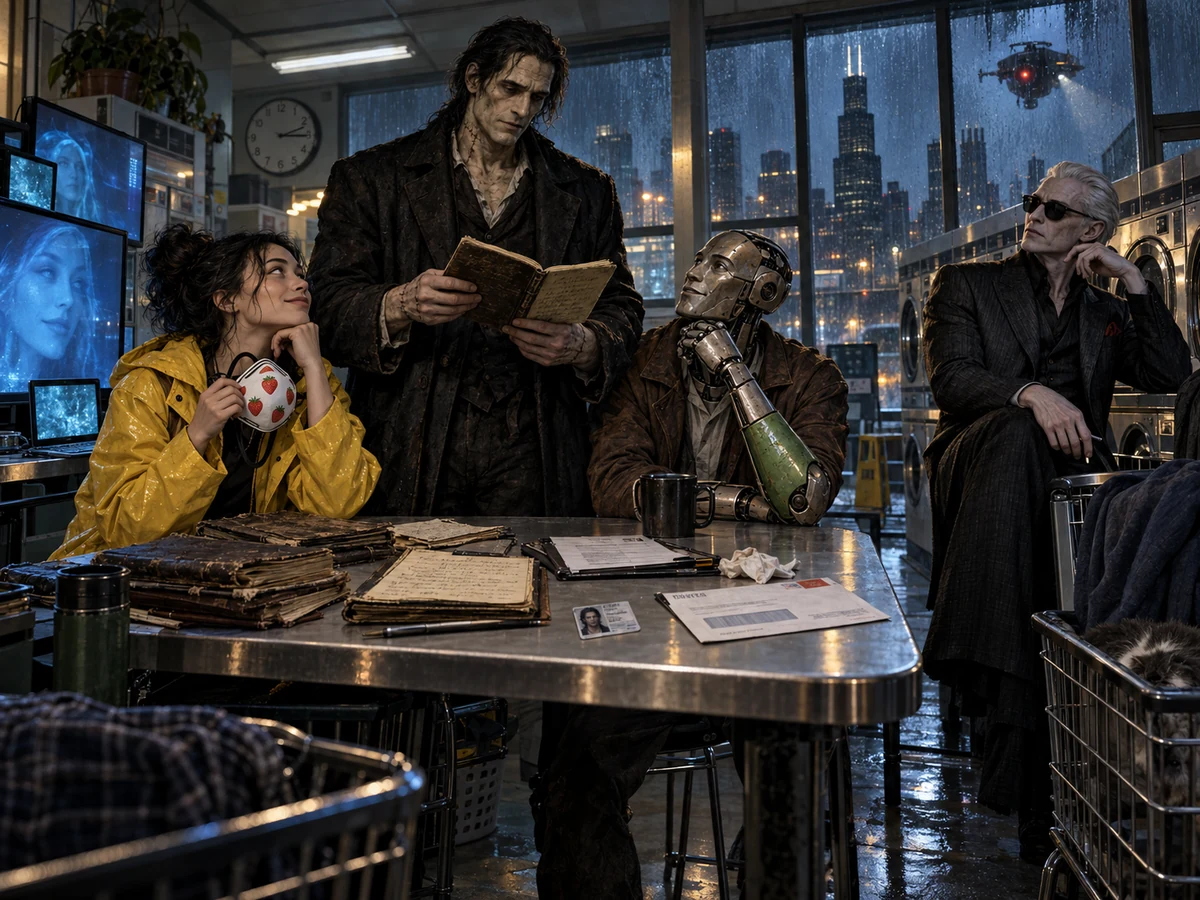
Proposal A continues the 1818 public-domain novel's own central conflict—an intelligent unnamed Creature is brought into life, denied care and recognition by his creator, and forced to ask what creation obliges—into twenty-first-century Chicago. The Creature remains the protagonist and has survived for two centuries; modern identity systems call him fraud or robot while Prometheus Holdings turns Victor Frankenstein's abandoned research estate into a claim that created bodies are proprietary outcomes. The new cast broadens, without resolving, the original question: Mirelle is a living biological AI who refuses to be assigned as the Creature's compensatory family; Caliper is an embodied robot whose chassis is financed; Omnia is a distributed virtual AI vulnerable to disconnection; Elias Drawe is a vampire who survives through corporate paperwork. The tone is contemporary black comedy and American institutional humor. Only Mary Shelley's original public-domain premise and characters are continued; no wording from a modern translation, protected commercial adaptation, actor likeness, neck bolts, flat-headed film-monster design, or other adaptation-specific expression is used.
Adapted into
Classics Adaptation · Black Comedy · Serialized Fiction
Mr. Frankenstein, Please Confirm You Are Not a Robot
The Creature After Two Hundred Years
Mary Shelley's unnamed Creature has survived into twenty-first-century Chicago, only to discover that banks think he is fraud, an identity kiosk thinks he is a robot, and a conglomerate thinks he is intellectual property. His appeal brings him into uneasy company with a vampire, a biological AI, an embodied robot, and a distributed intelligence—none of whom owes him a family, but each of whom has received an invoice for being created.